International
Balanced investment choices by the UK government include both capital and revenue investments, that aim to deliver long-term prosperity and ensure that the UK remains an economic and military power with great political and cultural influence around the world. There is also an urgent need to get all Sustainable Development Goals back on track.

UK Internationalisation Fund
The Department for Business and Trade (DBT) commissioned WECD to undertake monitoring and evaluation of the UK Internationalisation Fund (IF). IF was launched to offer co-investment funding to small and medium enterprises (SMEs) to support their efforts at business growth and diversification through internationalisation.
The rationale for the programme was predicated on the UK Government’s commitment to strengthen the UK’s position as a 21st century trading nation. As such IF has been part of successive government strategies to alleviate a series of barriers identified as preventing UK businesses ‘reaching their export potential’ (with a target/ambition to provide co-funding to around 7,500 businesses between 2021 and 2024 as part of this funding).
To support the Department’s work, WECD adopted a mixed methods formative and summative assessment drawing on extensive qualitative and quantitative research. This included surveys with businesses, in-depth case studies with businesses, one-to-one interviews and focus groups with local stakeholders across England, descriptive and statistical analysis and linking of various relevant datasets. All used to inform process and impact evaluations, counterfactual impact assessment and the production of quarterly reports and dashboards.
The funding/programme was designed to be delivered under four regional project areas: London, the South, Midlands, and Northern. WECD brought together, led and managed both in-house and external expertise to provide the client with just-in-time deliverables: Hatch, Belmana and Winning Moves.
WECD also completed an independent assessment of the effectiveness of the services delivered by the West Yorkshire Combined Authority (WYCA) Export for Success Programme launched under the brand of West Yorkshire Business Boost (WYBB) to help West Yorkshire SMEs to trade more and trade better, and delivered by Exemplas Ltd. This review was built around the OECD Development Assistance Committee (DAC) criteria.
Transnational Education and International Education Partnerships
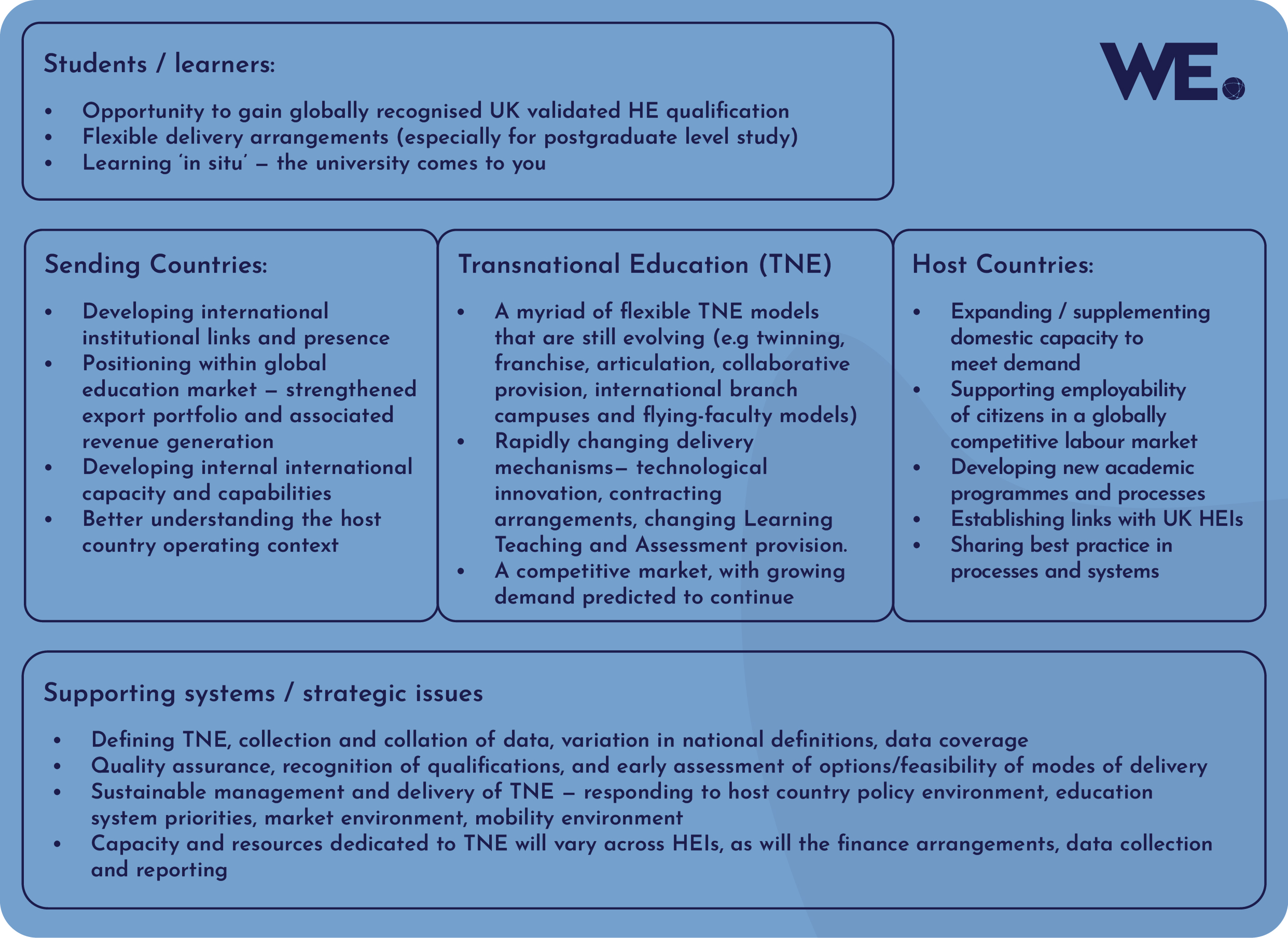
Transnational Education (TNE) activity includes education programmes that take place outside the UK, either through partner institutions, or directly through distance learning or international campuses. Work delivered for the Department for Education estimates that total UK revenue of education related exports and transnational education activity (TNE) activity in 2022 was £32.3 billion.
WECD work has also shown that benefits go over and above financial gains, and can be everlasting for learners, organisations and countries involved.
WECD have been commissioned over the years by Universities UK International (UUKi) and The British Council to demonstrate the wide range of reasons and ways in which UK universities are engaged in TNE – and the change in scope and extent of TNE over time. See reports here and here.
Typical tasks to produce these reports have included:
- Mapping the extent of of UK higher education TNE, primarily by country, institution and programme type and utilising HESA
- Showcasing mutual benefits for the institutions involved, academics, students and local economies, and highlighting innovation and diversity in approaches and models of practice through a relatively large number of case studies based on desk-based research and interviews with academics in the UK and host locations around the world
- Summarising key messages and sharing tips for successful and sustainable TNE provision
WECD was also commissioned to review the process and impact of the UK China Partners in Education Programme (UKCPIE) funded by the UK Government and involving institutions across all four nations. The evaluation commenced with a systematic review of policy documents and past departmental reviews. This was followed by extensive consultations with key stakeholders in China and the UK in the form of face-to-face and telephone interviews with UK government officials (central government and all the nations), The British Council, Association of Colleges, officials from the Chinese Ministry of Education, key players in the education sector in the UK and China and the managing organisations/agents of various strands of the programme. Interviews were also conducted with students, colleges, universities and employers involved in the programme in the UK and China. Evidence from the study provided inputs to inform CSR considerations.
Global Science and Research
The Global Challenges Research Fund (GCRF) is a £1.5 billion fund announced by the UK Government in late 2015 with the aim to support cutting edge research that addresses the problems faced by developing countries, whilst also enhancing the UK’s capacity to deliver cutting-edge research. The fund has formed part of the UK’s Official Development Assistance (ODA) commitment.
The Government allocated £58 million from this fund to Research England for distribution to English universities who received Quality-related Research (QR) funding. To demonstrate that GCRF funds are being spent on ODA-compliant activity and to support the case for continued funding, Research England implemented a triennial exercise in which HEIs submit a strategy outlining their overarching strategy for development-related research activity and how it intends to prioritise and spend QR GCRF allocations. Research England appointed WECD to provide expert support and independent advice to ensure that HEIs have robust and sustainable strategies in place to spend their QR GCRF allocations and that all activity undertaken using this funding is ODA compliant, therefore providing a sound basis for release of future funding and external scrutiny.
In 2025, the UK government took the decision to temporarily reduce ODA to the equivalent of 0.3% of gross national income (GNI) by 2027 to fund an increase in defence spending. The government remains committed to international development and to returning ODA to 0.7% of GNI when fiscal conditions allow. Nonetheless, GCRF supports UK and international researchers and innovators in taking on key issues affecting developing countries through:
- challenge-led multidisciplinary research
- strengthening capability for research, innovation and knowledge exchange
- providing an agile response to emergencies
See: https://www.ukri.org/who-we-are/epsrc/relationships/international-partnerships/