Skills and Labour Markets
CDTs
WECD was commissioned by the University of Bath to assess the impacts of its Centre for Doctoral Training (CDT) at the University of Bath’s Centre for Sustainable and Circular Technologies (CSCT). The purpose of the research was to provide an overview of the work of CSCT’s CDT programme and monetise the benefits and impacts arising from the CDT programme and its students and alumni. The programme brought together fundamental science and engineering mainly in four areas, as follows:
- Energy & Water
- Renewable Feedstocks & Biotechnology
- Processes & Manufacturing
- Healthcare Technologies
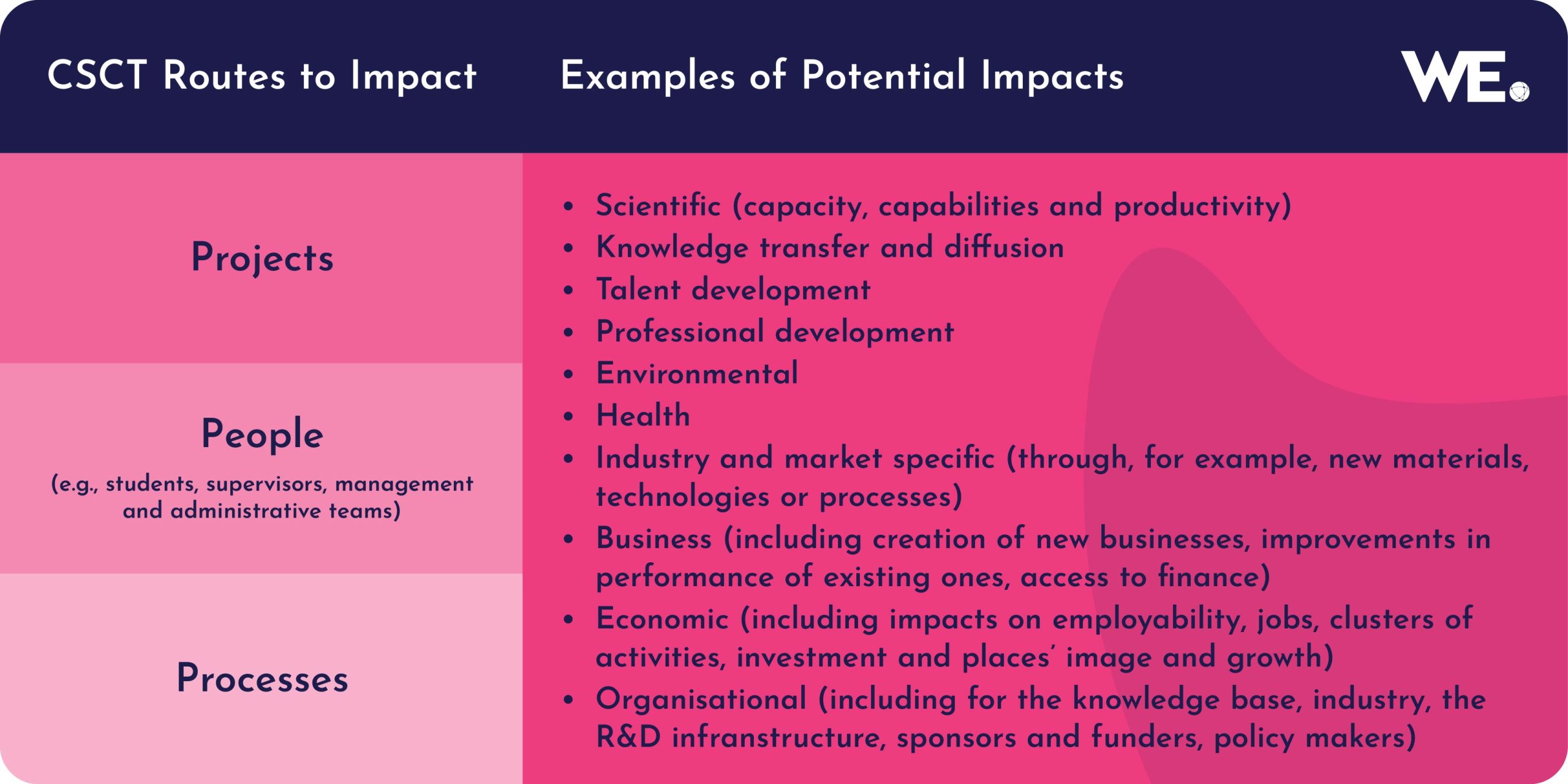
WECD identified three routes to impact for CSCT: projects, people, processes (e.g. interdisciplinary model) – with the emphasis of this work on people
A mixed methodology was adopted including interviews and an online survey with CDT students to gauge views about the training programme and its benefits and influence on their professional development and career pathways (including employment, promotion, earnings, start-ups etc.). All past and current doctoral students were invited to participate in the research, resulting in 11 one-to-one interviews and 26 responses to the online survey. Feedback was sought and received from six academic supervisors. Findings from this research were complemented by review of secondary sources of information and data (including Longitudinal Education Outcomes (LEO) and salaries and earnings data) to access and compare equivalent data (e.g., median salaries among graduates and postgraduates in /from specific science sectors) with the CTD students’ employment and earnings status. Within the timescale of this research, it has not been possible to design a programme-specific counterfactual and draw on other possible sources of data, for example, exploring career pathways of comparable non-participants in this programme (these could be those who applied to the programme but either decided not to go ahead with the offer or were not accepted) or other doctoral training programmes. The population of participants in the programme to date also represents a relatively small group of doctoral students over a relatively short period of time since the first cohort graduated to assist with establishing a suitable comparable group (or groups) of unsupported doctoral students for the counterfactual.
All information was brought together to present: a) headline achievements including standard scientific ones (e.g., publications) as well as knowledge transfer and diffusion (e.g., based on graduate destinations and nature and extent of collaborations); b) case studies (7) depicting the doctoral training from the students’ point of view and illustrate the influence of the programme on their career pathways; and c) monetized economic benefits (Gross Value Added) accrued to individuals (and the economy) through the Centre’s training programme and skills and qualifications acquired in the process.
Royal Academy for Engineering
We delivered the evaluation of the Leaders in Innovation Fellowships (LIF) advance, an RAE programme funded through the Academy’s Newton Fund, that brought together emerging leaders with an engineering-based innovation (focus on disability inclusion and reducing inequalities in access to healthcare) with potential to contribute to social and economic development through commercialisation. The programme was delivered by SETsquared Partnership. The evaluation tasks included review of programme data, interviews with key stakeholders and participants and production of an evaluation report compliant with DSIT guidance and case studies (suitable for digital media).
WECD has conducted evaluations and assessment of benefits and impacts of RAE’s Enterprise Hub and an evaluation of the RAE’s Engineering Leadership Awards (for RAE), and similarly to LIF, the evaluation involved interviews with stakeholders, mentors, mentees and their organisations.