Sectors
Automotive
The University of Bath commissioned WECD to undertake background research and analysis (market and economic impact assessment) to inform University decisions to invest (and seek additional external investment) of a world-class Institute for Advanced Automotive Propulsion Systems (IAAPS) at the University of Bath.
The IAAPS would build on the achievements of the University’s Powertrain and Vehicle Research Centre (PVRC) to deliver transformational R&D for future generations of low carbon vehicles (such as electric, hybrid and alternatively fuelled cars). Facilities would be used by Original Equipment Manufacturers (OEMs), Small & Medium sized Enterprises (SMEs) and supply chains, including other research centres and higher education institutions.
Consultations with researchers and industry and our team’s knowledge enables us to map out technologies and processes in the automotive sector that could be affected by the research undertaken by the Institute. We used this mapping to build a bespoke economic model to establish the potential impacts (market, economic and environmental) arising from this research on the automotive sector, the UK and local economy.
To further support the economic and business case for public funding our team also benchmarked the Institute’s potential positioning among similar research centres in the UK.
Clean energy - Low-Cost Nuclear technologies and assessment of the potential for the UK Market
WECD was commissioned to undertake market research related to nuclear energy technologies – Small Modular Reactors (SMRs).
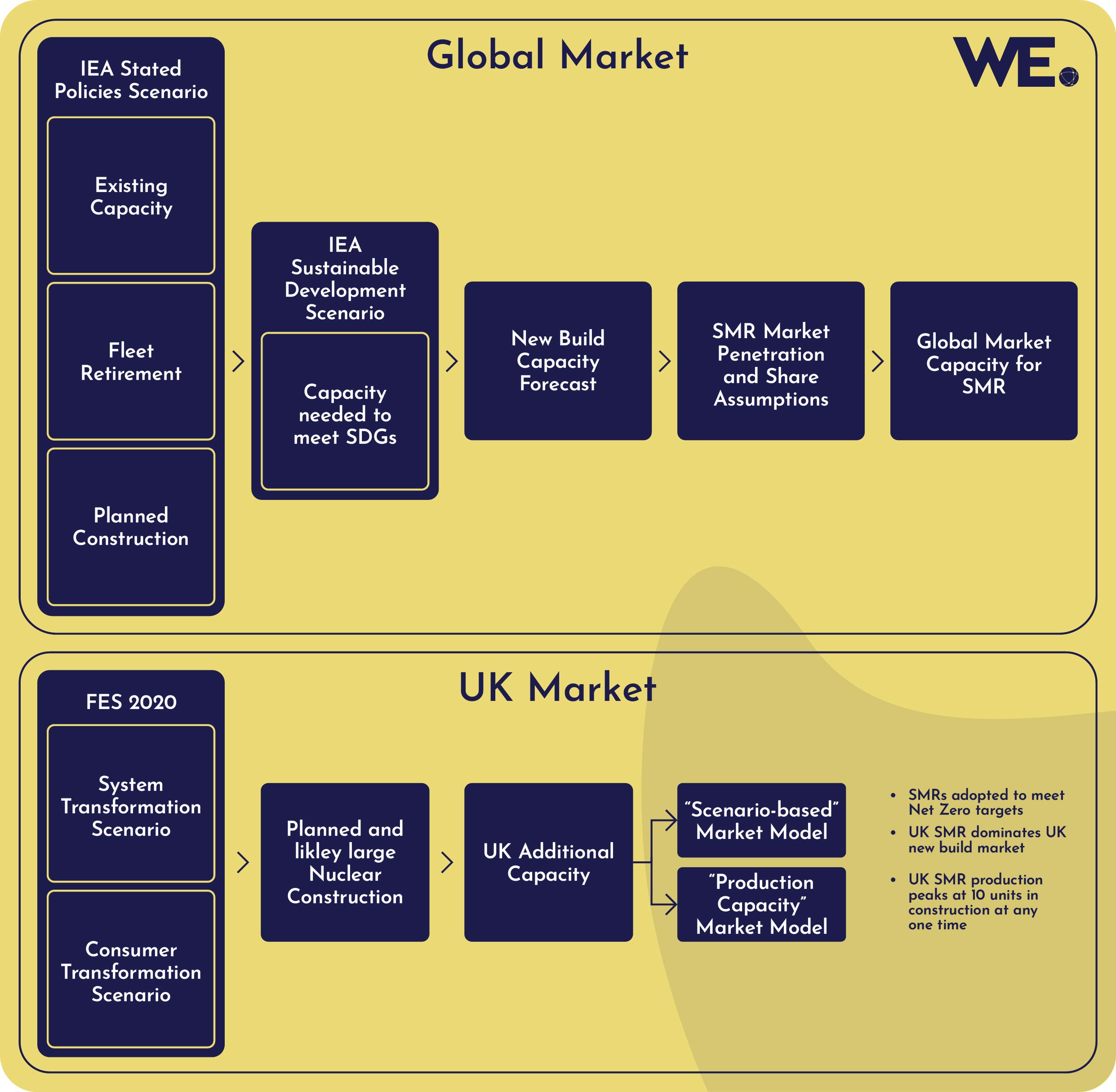
The research explored the global market for SMRs and produced estimates of the global market share of a UK SMR design (utilising International Energy Agency and NESO Future Energy Scenarios). Assessment of the market for SMR technologies was based on scenario modelling (including sensitivity analysis informed by discussions with the industry), estimating both the global and the UK markets for nuclear generated capacity (including new build capacity). Applying speed of market penetration and market share assumptions on these estimates provided an assessment of the market for SMR capacity. Market share assumptions for UK SMR in the wider SMR market were then used to estimate the potential market value of UK SMR exports.
A high-level assessment of economic benefits was also produced (in terms of Gross Value Added, jobs and exports) arising for the UK economy from various alternatives to develop SMRs for deployment in the UK. Options development was based on information provided by UKRI and DESNZ (the client group) and consultations with the key industrial and academic partners of the project. This information included estimates of the cost of SMR (design and development work), and the number of units that could be deployed following the completion of the design work.
The market and economic assessments also drew on systematic literature review, desk-based research into clean energy and nuclear investments in Canada, France, Russia, South Korea and the United States and in-depth interviews with scientists, academics, sector experts (e.g. NIRO and NIRAB) and industry (e.g. Rolls Royce).
Low Carbon Vehicles
The University of Bath commissioned WECD to undertake background research and analysis (market and economic impact assessment) to inform University decisions to invest (and seek additional external investment) of a world-class Institute for Advanced Automotive Propulsion Systems (IAAPS) at the University of Bath.
The IAAPS would build on the achievements of the University’s Powertrain and Vehicle Research Centre (PVRC) to deliver transformational R&D for future generations of low carbon vehicles (such as electric, hybrid and alternatively fuelled cars). Facilities would be used by Original Equipment Manufacturers (OEMs), Small & Medium sized Enterprises (SMEs) and supply chains, including other research centres and higher education institutions.
Consultations with researchers and industry and our team’s knowledge enables us to map out technologies and processes in the automotive sector that could be affected by the research undertaken by the Institute. We used this mapping to build a bespoke economic model to establish the potential impacts (market, economic and environmental) arising from this research on the automotive sector, the UK and local economy.
To further support the economic and business case for public funding our team also benchmarked the Institute’s potential positioning among similar research centres in the UK.
Circular economy
UKRI EPSRC commissioned WECD to review the Outcomes and Impacts of the UKRI Plastics Research and Innovation Fund (PRIF) – a £20 million programme aiming to contribute to tackling the issue of plastic waste, and support a move towards more circular economic and sustainable approaches to plastic production, use, and disposal.
The programme funded 65 projects via three funding streams: leadership and knowledge exchange, research(university)-led ‘creativity’ funding, and industry-led ‘innovation’. The projects include 8 academic-led projects, and 53 business-led projects.
The delivery of the programme has been based on multi-agency engagement involving a number of organisations working together. These have included EPSRC, NERC, Innovate UK, WRAP and the Knowledge Transfer Network, as well as an investor partnership with Sky Ocean Ventures.
Our analysis established that found that that 1 in 2 of jobs created with the support of the fund were long-term high value added jobs. The funding also supported knowledge transfer partnerships and secondments, internships and apprenticeships.
Project activities funded by the Fund have also resulted in approximately: 7,121 tonnes of plastics being diverted from landfill and incineration, or ending up as pollution; and, 5.7 million kg of reduced CO2 emissions.
Furthermore, a significant volume of academic research outputs in the area of reducing plastic waste (particularly single-use plastic) have a high potential to generate additional environmental benefits. The Fund is also supporting the development of processes that are certain to improve recycling and waste managements in the future, for example, by adapting current processes to more effective recycling of hard to recycle materials such as textile.
Health
In England, general practices are incentivised through two main schemes:
- Quality and Outcomes Framework (QOF)
- Investment and Impact Fund (IIF)
These schemes aim to enhance healthcare delivery and patient outcomes by incentivising continuous improvement in clinical care and public health delivery. Practices that achieve the targets set in these schemes receive additional income to their core funding. On behalf of the Department of Health and Social Care (DHSC) WECD conducted a thorough analysis of the over 1,000 responses to the Government consultation of the two frameworks.
Culture, Media and Sport
Youth programme – Birmingham 2022 Commonwealth Games
- WECD team were commissioned by the Birmingham Organising Committee for the 2022 Commonwealth Games to review the Bring the Power Youth Programme, and support the Bring the Power Youth Programme team in their reporting to the funders of the Programme (including DCMS) and the Birmingham 2022 Commonwealth Games wide evaluation). Using the Games as a catalyst for youth engagement, the Birmingham Organising Committee for the 2022 Commonwealth Games and Games Partners sought to use the platform of the Commonwealth Games to inspire and engage thousands of children and young people through Games-wide youth engagement activities. This was about ensuring the social benefits from the Games are experienced by as many children and young people as possible across the West Midlands and beyond.
The programme involved young people in every stage of its design and delivery, and the evaluation has shown that the programme reached diverse population groups and communities. Activities undertaken by participating schools and community youth hubs and organisations always aimed to encourage social mixing from diverse communities and groups to improve attitudes and perceptions held of people from different backgrounds. Programme activities also brought together sport and creativity, encouraging and inspiring young people for the next steps in their schooling and life development.
- WECD’s work involved: a) desk-based analysis of programme and project monitoring data; b) a large number of interviews with project leads and programme sponsors; c) participation in workshops and events with young people in London and Birmingham; and d) desk-based review of literature and national data to complement the programme data analysis.
MyWorld – Bristol Vision Institute
Bringing together 13 diverse, world-leading partners across academia and industry, MyWorld is using investment into creative technology innovation to stimulate growth and societal change in the industry and in the region.
The key dynamics driving consumer demand in screen-based media are increased immersion in high quality imagery, increased personalisation and increased accessibility and availability at any time and place. The world-leading team of collaborators engaged in MyWorld deliver a pipeline of prototype productions, methodologies and technologies, based on a backbone of new infrastructure, fundamental research programmes, and research and development collaborations.
The University of Bristol commissioned WECD to build a strong business case for public investment for this project. Our team conducted market research that underpinned the rationale for public funding, produced the economic case (and potential economic and wider impacts from his funding and the activities funded), and identified future Key Performance Indicators (KPIs) through which the prospective impact of the project could be assessed.
MyWorld secured £30 million in funding from the Strength in Places Fund.
National History Museum – Options for the Collections Programme
Food
Click here to view our Food case study page.
Space
WECD has conducted a number of research and evaluation projects for the UK Space Agency (UKSA) and the Satellite Applications Catapult. These have included: the review of UK Space Incubator Network; assessment of the UK Regional Centres of Excellence for Satellite Applications; and a process and impact evaluation of the Centre for Earth Observation Instrumentation – with all programmes supporting collaborations for innovation, new business creation and capitalising on increasing commercial opportunities in the fast-growing space economy.
The Space Growth Action Plan 2014-30 put a plan in place that would lead to a UK space sector with £40 billion per annum of space-enabled turnover and the creation of 100,000 new jobs. One of the Space Growth Action Plans suggestions was to ‘Work with Northern Ireland, Scotland, Wales, Local Economic Partnerships and Councils to develop regional growth plans for Space and secure non-Space funding for new projects, centres-of-excellence and business incubation centres across the UK.’ Within this context UKSA established the UK SpIN of 15 incubator centres across 22 locations in the UK. WECD were commissioned to review the activities of the incubators and estimate its impacts on growing the space tech community.
WECD were commissioned by UKSA and the Satellite Application Catapult to review the Centres of Excellence (CoE) programme and make recommendations for the programme’s future strategic direction going forward. Centres of Excellence included those in the in the East Midlands, North East, South Coast, South West and Scotland. Our team review detailed programme data from each region, explored extensive general sector (satellite applications and space) local and national business data (core activities and supply chain), and gathered evidence from a range of stakeholders via individual interviews and roundtable discussions.
As the latest contract for CEOI was coming to an end, UKSA commissioned WECD to independently review the CEOI programme. The main aim of the evaluation was to provide evidence, insight and recommendations to inform the Agency’s decisions on how best to continue supporting the UK Earth observation sector in the coming years, in the wake of the strategic direction set out by the National Space Strategy and resulting opportunity to develop the UK’s national space programme. In a short period of time our team conducted a range of primary and secondary research activities.